Nova
Title: Nova: The Cosmic Phenomenon That Illuminates Our Universe
Introduction
In the vast expanse of the universe, celestial events captivate our imagination and deepen our understanding of cosmic processes. Among these phenomena, novae (the plural of nova) stand out as brilliant bursts of light that serve as indicators of stellar evolution and the complex interactions between stars. A nova occurs when a white dwarf star, often in a binary system, undergoes a cataclysmic explosion due to the accumulation of hydrogen from its companion star. This phenomenon not only sheds light on stellar life cycles but also offers clues about the composition of our universe. In this blog post, we will delve into the mechanics of novae, their historical significance, their role in the cosmic ecosystem, and their implications for our understanding of the universe.
Understanding the Mechanics of a Nova
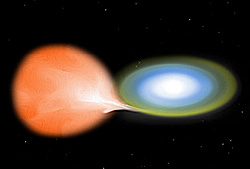
At the heart of a nova is the white dwarf, the remnant core of a star that has exhausted its nuclear fuel. When this white dwarf is in a binary system—a system containing two stars—its gravitational field can draw material from its companion star. This material, usually hydrogen, accumulates on the surface of the white dwarf until it reaches a critical pressure and temperature. When the conditions are right, a runaway thermonuclear reaction ignites, causing a sudden and dramatic increase in brightness. This explosion can make the nova outshine entire galaxies for a short period, sometimes increasing its brightness by up to a million times.
The process is not only spectacular but also intricate. The explosion typically lasts from a few days to a few weeks, after which the nova gradually fades back to its original state. Unlike supernovae, which are the explosive deaths of stars, novae are recurring events. Some binary systems can experience multiple nova outbursts over time, allowing astronomers to study these events repeatedly and gain insights into their underlying mechanisms.
Historical Significance and Cultural Impact
The phenomenon of novae has been observed for centuries, with records dating back to ancient civilizations. The most famous historical nova occurred in 1572 when the Danish astronomer Tycho Brahe observed a new star in the constellation Cassiopeia. Dubbed "Tycho's Star," this event challenged the long-held belief that the heavens were unchanging. This nova was not only pivotal in the development of modern astronomy but also influenced the scientific revolution, prompting scholars to question the nature of the cosmos.
In different cultures, novae have been interpreted in various ways, often seen as omens or messages from the divine. In Japan, for example, novae were linked to the spirits of ancestors, while in Europe, they were associated with significant events in history. The cultural impact of novae illustrates humanity's long-standing fascination with the cosmos and our desire to find meaning in the stars.
The Role of Novae in Stellar Evolution
Novae are not just mere spectacles; they play a crucial role in our understanding of stellar evolution. The study of these explosions provides insights into the life cycles of stars and the interactions between them. Moreover, novae contribute to the chemical enrichment of the universe. When a nova explodes, it ejects material into space, enriching the interstellar medium with heavier elements formed during the thermonuclear reaction. This material can later be incorporated into new stars and planets, contributing to the cycle of stellar birth and death.
Additionally, novae serve as essential tools for astronomers in measuring cosmic distances. The brightness of a nova can be used as a standard candle, allowing researchers to calculate the distance to the host galaxy based on its observed luminosity. This method has significant implications for our understanding of the expansion of the universe and the nature of dark energy.
Future Research and Observations
As technology advances, our ability to observe and study novae continues to improve. Space telescopes like Hubble and the upcoming James Webb Space Telescope (JWST) are expected to provide unprecedented views of these explosive events. By capturing data across different wavelengths, astronomers can gain deeper insights into the composition of the ejected material, the dynamics of the explosion, and the properties of the binary systems involved.
Moreover, ongoing research into the frequency and distribution of novae in different types of galaxies can help scientists understand the conditions that favor these explosive events. With the rise of citizen science projects and collaborative efforts across the globe, the study of novae is becoming increasingly accessible, allowing amateur astronomers to contribute to our understanding of these celestial wonders.
Conclusion
Novae are more than just stunning cosmic fireworks; they offer profound insights into the workings of our universe. By studying these explosive events, astronomers can unravel the complexities of stellar evolution, enhance our understanding of the cosmic ecosystem, and even draw connections to the broader narrative of the universe’s expansion. As we continue to explore the mysteries of the cosmos, novae will undoubtedly remain a focal point of research and fascination, illuminating the dark corners of space and time while igniting our curiosity about the stars. In the grand tapestry of the universe, novae shine brightly, reminding us of the beauty and complexity of the cosmos we inhabit.